Mars V5 AI 15kg Coffee Roasting System: A Complete Production Line from Loading to Packaging
In professional coffee production, producing one good roast batch is not enough to create a competitive advantage. For medium and large enterprises, what matters more is the ability to repeat consistent quality, control the production process, optimize labor, and manage production costs effectively.
The Mars V5 AI 15kg coffee roasting system project was developed by Mars Roaster with this direction in mind: to build an automated coffee roasting line that is synchronized from green coffee loading, roasting, cooling, post-roast processing, storage, blending, grinding, and conveying to the packaging stage.
This is not merely a 15kg coffee roaster. It is a complete production system designed for roasteries, coffee factories, agricultural product enterprises, and coffee brands that need to upgrade their operating capabilities toward a more modern, stable, and data-driven model.
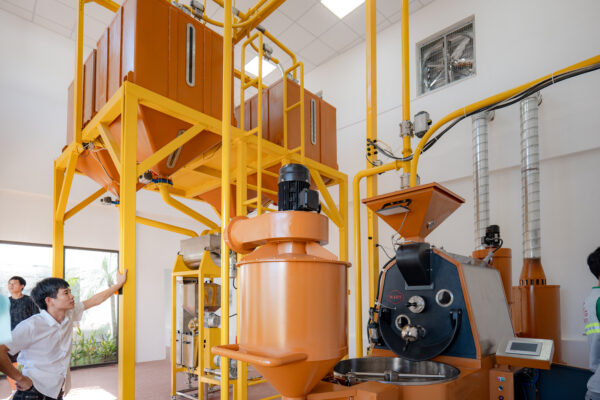
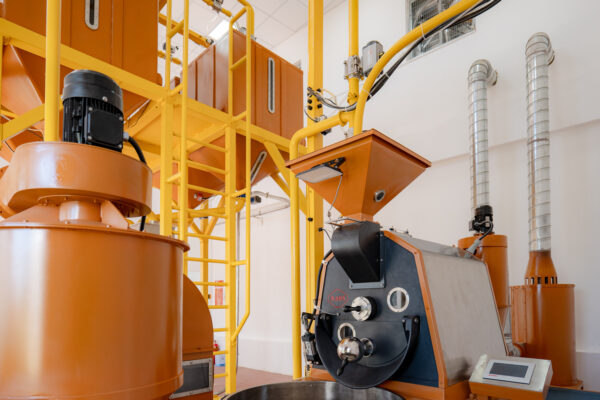
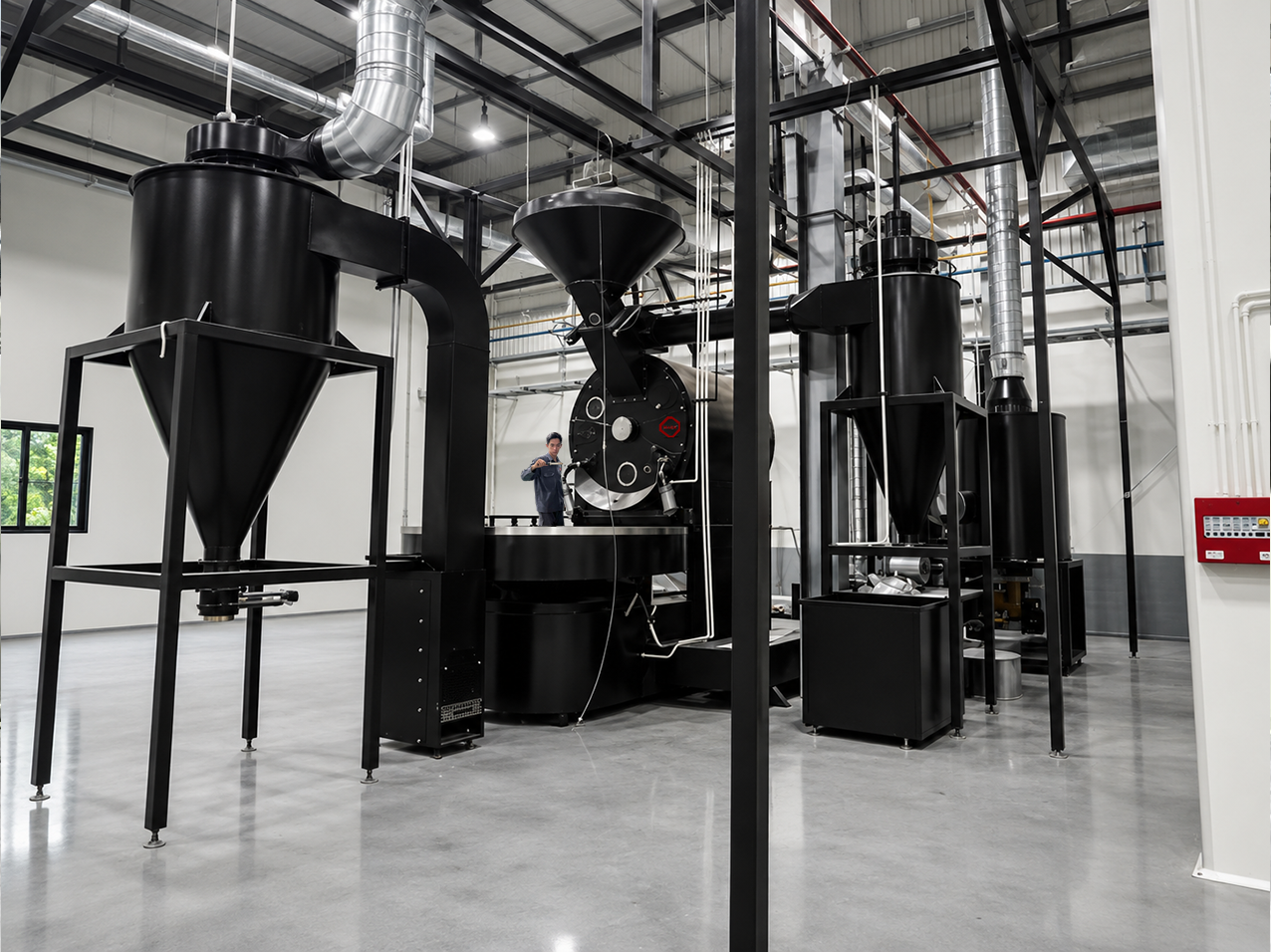
Overview of the Mars V5 AI 15kg coffee roasting system with silo clusters, loading pipelines, and synchronized processing equipment.
Project Overview: A Complete AI-Powered Coffee Roasting Line
The system is built around the Mars 15 AI coffee roaster with a capacity of 15kg per batch, integrated with Mars V5 technology, using 100% hot-air roasting, and capable of operating in either automatic or manual mode depending on production needs.
The overall process includes:
Green coffee is loaded into the feeding silo. From there, the automatic weighing system measures the exact batch weight according to the preset roasting plan, then transfers the coffee into the roaster. The Mars 15 AI roaster performs the roasting process according to the selected profile. Once the roast is completed, the coffee is discharged into the cooling tray for approximately 3–4 minutes, helping stabilize the roasted beans and prepare them for the next processing stages.
After roasting, the coffee continues through the destoner system and is then transferred to four post-roast coffee storage silos. These silos can be assigned according to different raw materials or product profiles, such as Robusta, Arabica, base blends, or custom roast batches for specific orders. The coffee is then weighed and discharged into the mixer, grinder, or transferred to the packaging feeding system.
This layout enables enterprises to build a seamless production process, reduce manual handling, minimize weighing errors, and improve quality control at every stage.
1. Intelligent: Controlling Roast Profiles with Data
Mars V5 AI was developed to help operators control roast batches with greater precision and repeatability. The machine can store unlimited roast profiles, manage roasting records via computer, and operate flexibly between automatic and manual modes.
In modern coffee production standards, especially in the spirit of SCA practices, quality is not evaluated only by the color of the roasted beans. A roast batch must be controlled through factors such as temperature, time, development rate, airflow, consistency, and the ability to repeat profiles across multiple batches.
With Mars V5 AI, enterprises can digitize the roasting process, record parameters, track operating history, and reuse profiles for each product line. This is especially important for factories producing multiple coffee lines such as Robusta, Arabica, espresso blends, Vietnamese phin coffee, or commercial roasted and ground coffee.
Beckhoff hardware supports the control and monitoring of the Mars V5 AI roasting process.
2. Safe: Stable Operation for Industrial Production Environments
For an industrial coffee roasting line, safety is a mandatory factor. The Mars 15 AI system is configured with control devices, sensors, protection components, and a safe gas system to support stable operation in real production environments.
In addition to the roaster, the smoke and odor treatment system is also an important component. During roasting, smoke, odor, and chaff dust can affect the factory environment if not properly treated. The smoke and odor treatment unit helps reduce the impact of the roasting process, supporting a cleaner and more professional production space.
In addition, the post-roast destoner helps remove heavy impurities before the coffee enters the silo, mixer, or grinder. This step protects product quality and helps safeguard downstream equipment.
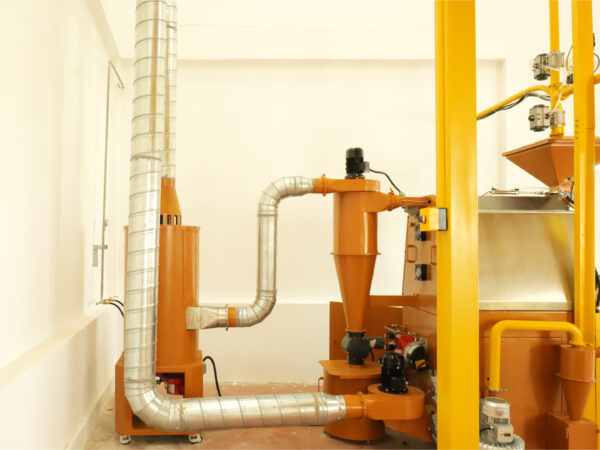
The two-stage smoke treatment system thoroughly processes smoke and odor.
3. Manageable: Controlling Production, Data, and Economic Efficiency
One of the strengths of Mars V5 AI is its production data management capability. The system allows profile storage, roasting parameter recording, operating history tracking, and remote monitoring support.
For medium and large enterprises, this data does not only serve roasting techniques. It also forms the foundation for production cost management: monitoring productivity by shift, evaluating consistency between batches, managing raw material norms, reducing losses, and minimizing dependence on a single operator.
When the process is standardized through data, enterprises can train new personnel more easily, transfer roast formulas, control quality across production lots, and expand capacity without compromising product consistency.
Production Line Configuration: From 1 Feeding Silo to 4 Post-Roast Coffee Silos
1 Green Coffee Feeding Silo: Accurate Weighing, Fast Loading, Reduced Errors
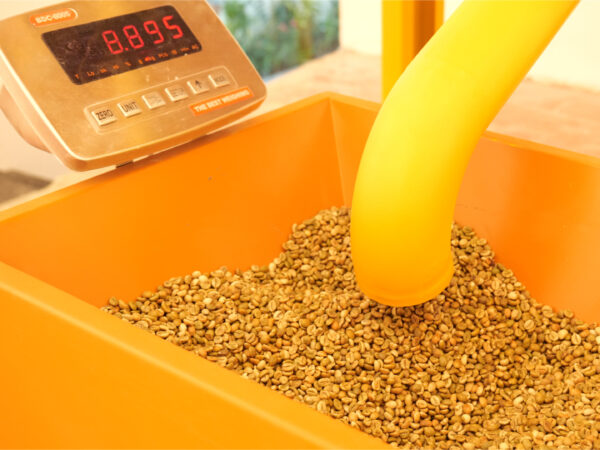
At the beginning of the line, the system uses one green coffee feeding silo. This silo is responsible for storing green coffee, connecting with the weighing system, and automatically feeding the roaster according to the selected weight.
Instead of weighing and loading each batch manually, the operator only needs to set the required weight according to the production plan. The system automatically weighs and loads the coffee, helping reduce weight errors, shorten batch preparation time, and reduce labor intensity.
This is an important stage in an automated coffee roasting line because batch accuracy begins with the weighing of raw materials at the input stage.
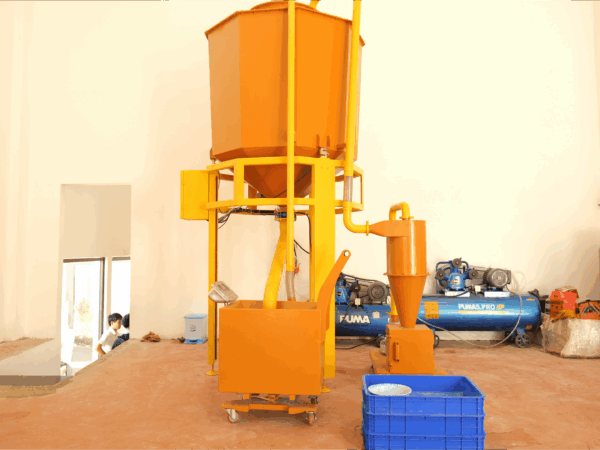
The green coffee feeding silo is integrated with a weighing system and automatic loading pipeline to the roaster.
Mars 15 AI Coffee Roaster: The Center of the Entire Production Line
The Mars 15 AI roaster is the core of the system, with a capacity of 15kg per batch, a roasting time of approximately 10–20 minutes depending on the profile, and a cooling time of approximately 3–4 minutes.
The machine uses 100% hot-air roasting technology, allowing coffee beans to be exposed to a stable stream of hot air during the roasting process. This heat transfer method supports better control of roast uniformity, especially when enterprises need to repeat multiple batches throughout the day.
Mars 15 AI can operate automatically according to stored profiles or manually when the roast master needs to fine-tune the process. This flexibility is suitable for both commercial production and new product development, where enterprises need both consistent quality and the ability to test profiles for different coffee types.
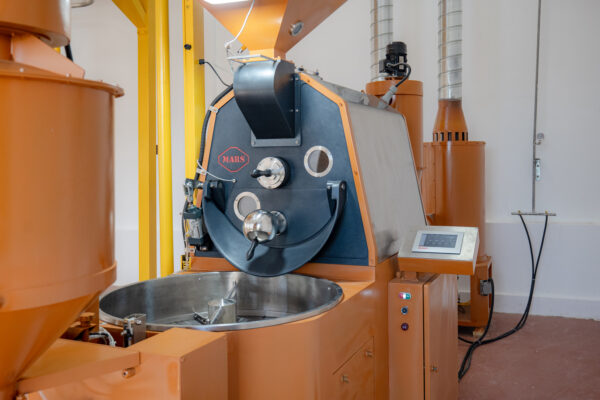
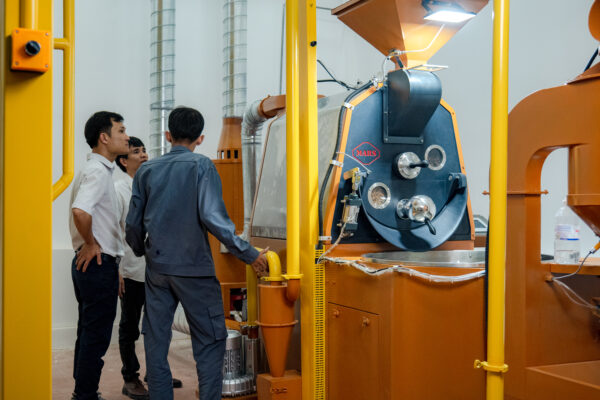
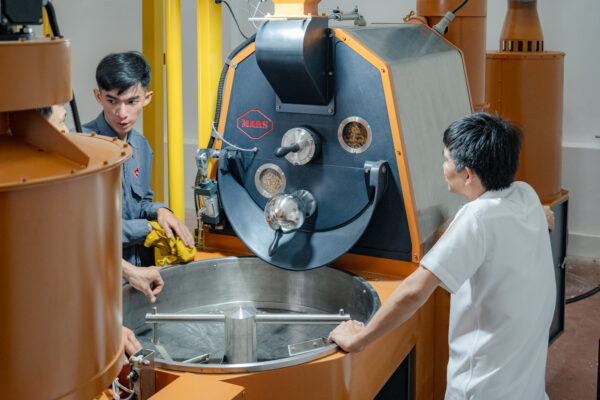
Checking the roast batch on the Mars 15 AI during test operation and profile adjustment.
3–4 Minute Cooling Tray: Stabilizing Beans After Roasting
After the roasting process is completed, the coffee is discharged into the cooling tray. The cooling time is approximately 3–4 minutes, helping reduce bean temperature quickly and stabilize the coffee after roasting.
This is an important step in quality control. If cooling is too slow, the beans may continue to develop due to residual heat, changing the flavor and consistency of the roast batch. When cooling is properly controlled, the roast profile is preserved more accurately, supporting consistency between batches.
Post-Roast Destoner: Protecting Quality and Equipment
After cooling, the coffee is transferred through the automatic destoner. This equipment helps remove heavy impurities that may remain in the coffee, such as small stones or foreign objects.
For large-scale production enterprises, a destoner is an essential component. It helps protect the grinder, reduce the risk of equipment damage, and contribute to finished product quality before the coffee enters the post-roast storage silos.
4 Post-Roast Coffee Silos: Separating Robusta, Arabica, and Product Lines
After post-roast processing, the coffee is transferred into four post-roast coffee storage silos. This is an important upgrade in the system, allowing enterprises not only to store roasted coffee but also to manage post-roast materials by clear categories.
Enterprises can allocate the four silos according to production needs, for example:
Silo 1 stores dark-roasted Robusta for Vietnamese phin coffee products. Silo 2 stores medium-roasted Robusta for commercial blends. Silo 3 stores Arabica for espresso products or specialty blends. Silo 4 stores coffee roasted according to a separate profile, base blends, or custom orders.
Using four silos helps enterprises better control the blending and packaging process. Each type of roasted coffee is stored separately, reducing material mix-ups, supporting automatic weighing, and enabling the production of multiple product lines within the same system.
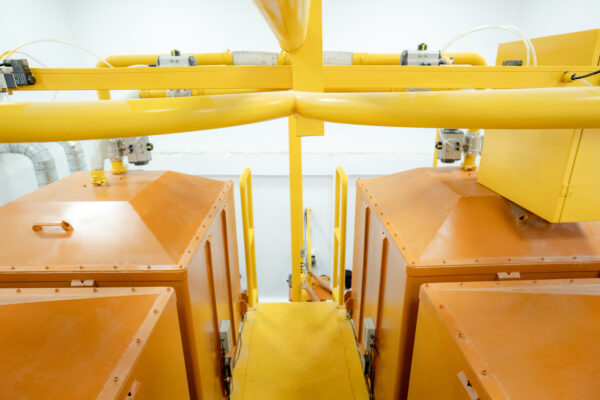
The cluster of four post-roast coffee silos supports the separation of Robusta, Arabica, and different product profiles.
From the four post-roast coffee silos, the system can weigh and discharge coffee into the mixer according to the preset formula. The 20kg/batch mixer supports the blending of different coffee lines, making it suitable for enterprises producing espresso blends, Vietnamese phin coffee, roasted and ground coffee, or commercial product lines.
When the mixer is connected with the silo and weighing system, the blend formula can be controlled more accurately. Enterprises can reduce blending errors, minimize dependence on manual handling, and maintain consistent quality across production lots.
Coffee Grinder: Controlling Consistency and Reducing Fine Particles
For ground coffee products, the grinder is a stage that directly affects the extraction experience. The grinding system in this production line has a capacity suitable for commercial production, supporting stable grinding, reducing fine particles, and limiting excessive heat buildup during grinding.
Integrating the grinder into the production line helps enterprises better control grind size, reduce raw material losses, and ensure that roasted coffee is processed within a more closed and consistent workflow.
Conveying System to Packaging: Completing the Closed Production Process
After blending or grinding, the coffee is transferred through the conveying system to the packaging machine. This unit helps automatically feed either automatic or semi-automatic packaging machines, reducing manual scooping and limiting direct contact with the product.
This is the final step that completes the production line, helping enterprises optimize production speed, reduce losses, and ensure that the process from roasting to packaging operates in a synchronized manner.
Benefits for Medium and Large Enterprises
Labor Optimization
The system automates multiple points in the process: loading, weighing, roasting, cooling, destoning, post-roast storage, blending, and conveying to packaging. As a result, enterprises can reduce manual operations and lower the workload for operating personnel.
Instead of requiring many people at different stages, the team can focus on monitoring, quality control, and production management.
Reduced Error Rate
Errors in coffee production often come from inconsistent weighing, mixing up coffee types, loading the wrong batch, incorrect blending ratios, or inconsistent operations between shifts. With the silo system, automatic weighing, and profile management, these errors can be significantly reduced.
The division into four post-roast coffee silos also helps enterprises clearly control each coffee type, such as Robusta, Arabica, or separate product lines. This reduces material confusion and supports a more structured production process.
Consistent Quality
Coffee quality requires consistency from raw materials, roast profiles, cooling, post-roast processing, blending, and packaging. When the entire production line is designed as a synchronized system, enterprises can control quality better than with a production model based on separate, disconnected equipment.
Mars V5 AI helps store profiles, monitor parameters, and repeat roasting processes. The silo and automatic weighing system helps control dosing. The mixer and grinder support stable output quality. Together, they create a more consistent production process.
Production Cost Management
With a data-driven system, enterprises can monitor productivity, control losses, manage raw material norms, and evaluate efficiency by production shift. This provides an important foundation for decision-making in cost control, output planning, staffing, and factory expansion.
A good production line does not only help roast better coffee. It helps enterprises understand how they are producing, where costs are generated, and which points can be optimized.
Evidence of the Advantages of Mars V5 AI Technology
Mars V5 AI creates differentiation by combining roasting technology, automation, and data management.
First, 100% hot-air technology supports stable and uniform heat transfer, meeting the requirements for controlled roasting in professional production.
Second, the system stores unlimited profiles, allowing enterprises to develop multiple product lines and repeat roast formulas when production needs to be replicated.
Third, the production line is integrated from one feeding silo to four post-roast coffee silos, along with a destoner, mixer, grinder, and conveying system to packaging. This demonstrates that Mars Roaster does not only supply coffee roasters, but also has the capability to implement factory-level solutions based on real production workflows.
Fourth, the system uses control and protection components from industrial brands such as Beckhoff, AVEVA, Siemens, Omron, Mitsubishi, and Ecoflam. This is an important foundation for stable operation in long-term production environments.
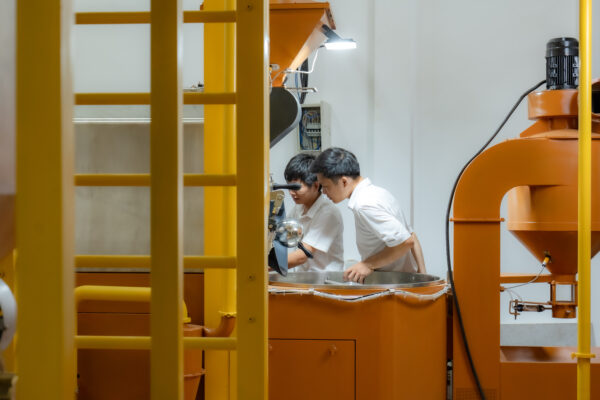
Test-running the Mars V5 AI 15kg roaster and checking the synchronization of all equipment units in the production line.
Mars Roaster: Capability to Implement Complete Coffee Roasting Lines
The Mars V5 AI 15kg coffee roasting system project is evidence of Mars Roaster’s capability to implement complete coffee production solutions for enterprises. From configuration design, equipment manufacturing, installation, system integration, test operation, and operating guidance, the entire production line is built according to the actual needs of the factory.
For enterprises expanding production, this is a transition from manual or semi-automatic roasting to a controlled production model. For medium and large factories, it is a foundation for increasing capacity, reducing labor, lowering errors, synchronizing quality, and managing production with data.
A modern coffee roasting system requires more than a good roaster. It needs a production line intelligent enough to control profiles, safe enough for long-term operation, and manageable enough to help enterprises grow sustainably.
That is the value delivered by Mars V5 AI and Mars Roaster’s complete production line solution.
Consultation for Mars V5 AI Coffee Roasting Systems
Mars Roaster provides coffee roaster solutions and automated roasting lines based on the actual production needs of each enterprise.
If you are planning to build a coffee roasting system from loading, roasting, cooling, destoning, post-roast storage, blending, grinding, and packaging, Mars Roaster can consult on a configuration that matches your factory scale, target output, and product direction.
MarsBot
Mars Roaster xin chào! MarsBot có thể giúp anh/chị chọn máy rang cà phê phù hợp.