Fully Automated Mars V5 90kg Coffee Roasting System
Mars V5 90kg Coffee Roasting System: When a Roasting Factory No Longer Has Waiting Time Between Batches
There is one very costly point in an industrial coffee roasting line that people outside the industry often do not see: the waiting time between two roast batches.
One batch has just been discharged. The operator starts weighing the next batch. Green coffee is moved into the hopper. The machine waits for loading. The production team waits for the machine to start the next batch. In a small production line, a few minutes of waiting may not seem significant. But for a factory producing tons of coffee every day, those few minutes mean unused capacity, idle labor, and operating costs increasing with every production shift.
The Mars V5 90kg coffee roasting system was implemented by Mars Roaster to solve exactly that problem: turning the roasting process from separate manual steps into a continuous production rhythm.
When the first roast batch is approaching its final stage, the system has already started preparing the second batch. If the profile is set for 20 minutes at 222°C, then at around the 18-minute mark, the automatic weighing unit begins measuring the required amount of green coffee. When the first batch is discharged, the second batch is almost ready to be loaded into the roaster. This cycle continues repeatedly, helping the production line operate with a steady rhythm, reducing downtime, and making better use of the 90kg roaster’s capacity.
But in an industrial system, the coffee flow is not the only thing that needs to be controlled. When the roaster operates continuously, the factory must also control the smoke, odor, chaff dust, and hot air generated during the roasting process. Therefore, in this project, the smoke treatment machine is not simply an add-on device to complete the configuration. It is part of the production rhythm: helping the roasting line become larger, cleaner, more stable, and ready for long operating hours.
That is the difference of an industrial roasting system designed with a factory mindset: not only roasting at a larger scale, but operating more intelligently and controlling the entire production environment.
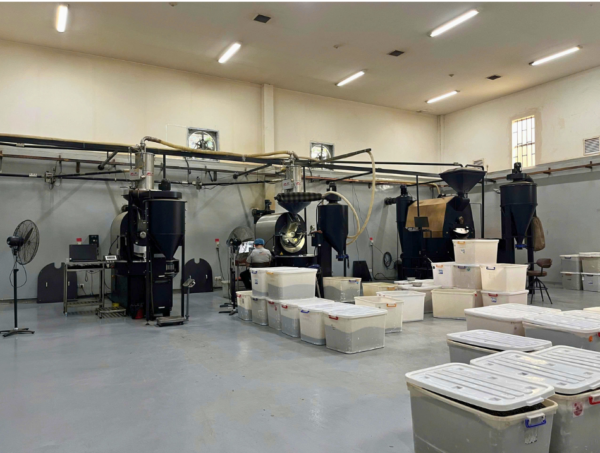
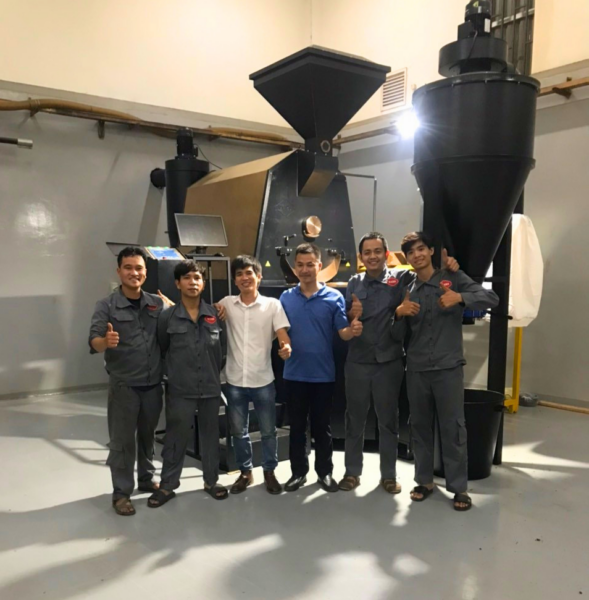
The 90kg roasting system operating in a real factory environment.
A Production Line Designed for Large-Scale Manufacturing
The Mars V5 90kg coffee roasting system project does not begin with the question: “How many kilograms can the machine roast per batch?” The more accurate question is: how many hours per day does the factory need to operate, how many coffee types does it need to process, how many batches must it control, how will smoke and odor be handled, and how many manual operations can be reduced?
From that question, the system configuration was built as a complete production line:
3 green coffee silos, each with a capacity of approximately 2.5 tons. An automatic weighing system for each batch size. A feeding unit that transfers green coffee into the roaster. A Mars V5
90kg coffee roaster operating according to roast profiles. A smoke treatment machine connected to the roasting process. A post-roast cooling unit. A destoner that removes heavy impurities after roasting. 5 roasted coffee silos, each with a capacity of approximately 1 ton. A control system that synchronizes all stages.
With this configuration, coffee is no longer processed in the way of “finishing one step before thinking about the next.” Each stage is programmed to coordinate with the next one. Green coffee is stored, weighed, fed, roasted, cooled, destoned, and transferred into finished-product silos through a controlled workflow.
At the same time, smoke and odor generated during roasting are also directed to a separate treatment system. This is an important factor for a 90kg line, because when the machine runs many batches continuously, the accumulated smoke is no longer a small issue. Good smoke and odor control helps the factory become cleaner, safer, and more professional in the eyes of operators, visiting customers, and production partners.
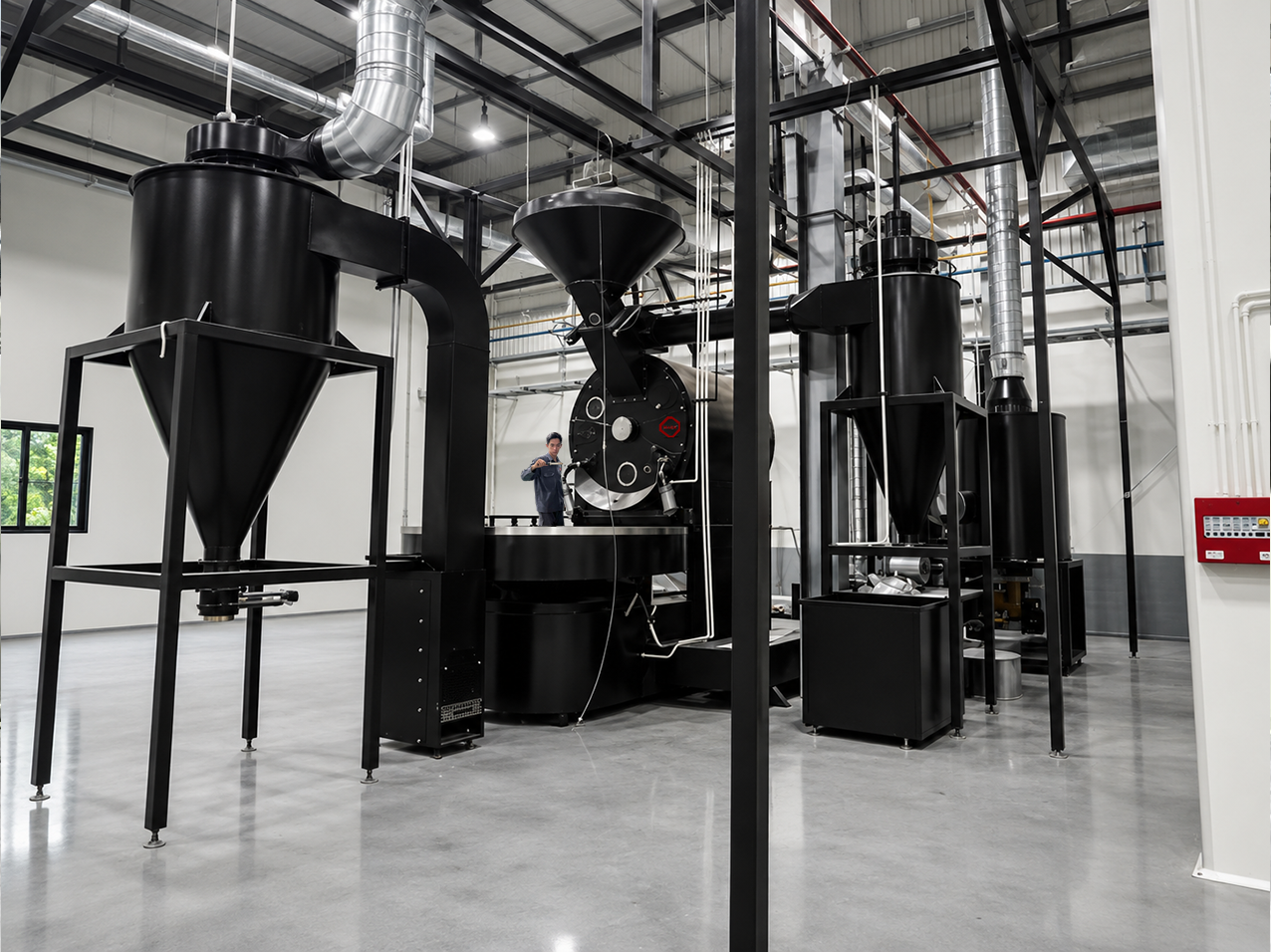
The 90kg coffee roasting line after completion and system synchronization testing.
Mars V5: Automation Based on Production Logic, Not Just Individual Automated Steps
Many people think automation simply means pressing a button and letting the machine run. With the Mars V5 line, automation is understood more broadly: the system must know when to weigh, when to feed, when to prepare the next batch, when to process smoke, and when to transfer roasted coffee to the next stage.
The key point of Mars V5 lies in its operating sequence. The operator sets the profile, batch weight, and production plan. The system then coordinates the equipment units according to a programmed logic.
In coffee operation following the spirit of SCA standards, consistency is not only about the color of the roasted beans. It is about controlling batch size, roast time, heat application, airflow, cooling, and the ability to repeat profiles. At a scale of 90kg per batch, even small errors in weight, waiting time, or feeding operation can multiply quickly throughout the production day.
Mars V5 helps reduce this risk by transferring key operations into the system: automatic weighing, automatic feeding, coordinated feeding timing, controlled discharge sequence, smoke and odor treatment during roasting, and the transfer of roasted coffee into storage silos.
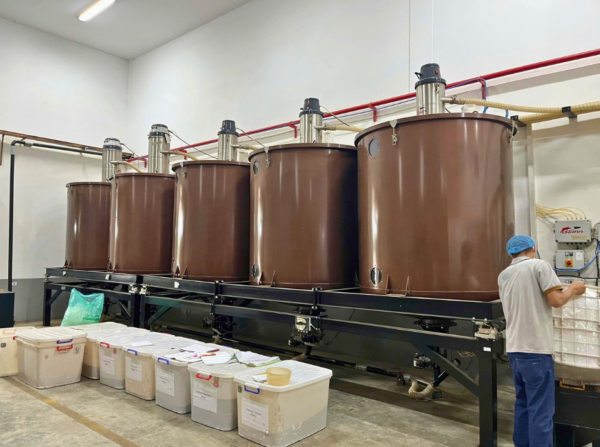
3 Green Coffee Silos: Organizing Raw Materials from the Start of the Line
At the beginning of the production line are 3 green coffee silos, each with a capacity of approximately 2.5 tons. These are not only storage units. They are the starting point of the entire production control strategy.
With 3 silos, the factory can separate green coffee by material type: Robusta, Arabica, or different coffee lots based on growing region, supplier, moisture level, bean size, and product objective. Separating raw materials from the beginning helps reduce the risk of material mix-ups before roasting.
When a production command is given, the system takes coffee from the appropriate silo, transfers it through the weighing unit, and prepares it for roasting. As a result, operators do not need to continuously move coffee bags manually, weigh large batches by hand, or deal with unnecessary input-stage errors.
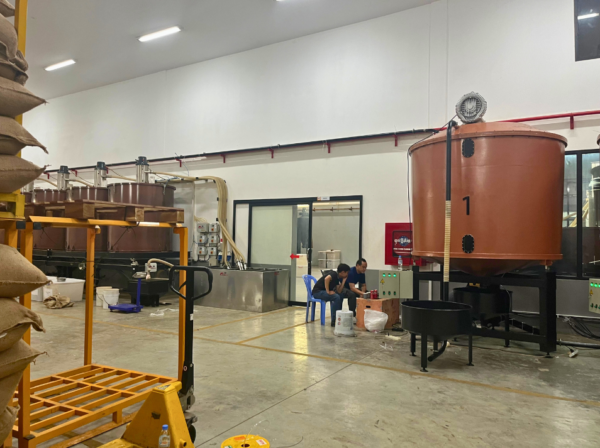
Coffee storage silos for an industrial roasting system.
Automatic Weighing: Controlling Batch Size Before Controlling the Roast Profile
A roast profile only makes sense when the batch size remains stable. The same profile with different input weights will create different thermal responses. With a 90kg machine, this becomes even more important because weight deviation can directly affect heat transfer speed, development time, and batch uniformity.
The weighing unit in the Mars V5 system is responsible for measuring the exact number of kilograms required. If the production plan requires 90kg, the system weighs that exact batch before feeding it into the machine. If the business wants to roast a different weight according to each profile or order, the system can also be configured according to operational requirements.
The benefit of automatic weighing is not only speed. The greater benefit is reducing repeated errors. A small error, if repeated across dozens of batches per day, becomes a real cost. Automatic weighing helps the factory control the process from the beginning, instead of dealing with errors at the end of the workflow.
Automatic green coffee feeding into the 90kg coffee roaster.
Automatic Feeding: The Next Batch Is Prepared Before the Current Batch Ends
This is the point that creates the operating rhythm of the system.
In a manual model, the roaster often has to wait for people. Waiting for raw materials to be weighed. Waiting for coffee to be moved into the hopper. Waiting for confirmation of the next batch. With an automated line, people shift from the role of “performing each step” to the role of “monitoring the production rhythm.”
While a batch is roasting, the system already knows when the next batch needs to be prepared. For example, with a 20-minute profile, at around minute 18, the weighing unit begins discharging the required amount of green coffee. The coffee is moved into the waiting position for loading. When the current batch finishes, the next batch can be fed into the machine more quickly, reducing the empty time between two cycles.
For a large-scale production factory, this mechanism creates a clear difference. The machine is no longer interrupted by raw material preparation. Staff no longer need to chase after every batch. Actual output moves closer to the designed capacity.
Mars V5 90kg Coffee Roaster: The Center of the Production Line
The 90kg roaster is the heart of the system. But in this project, the roaster does not stand alone. It is connected with green coffee silos, the weighing system, the feeding unit, the smoke treatment machine, the cooling unit, the destoner, and roasted coffee silos.
This connection turns the roaster into part of a production line, instead of an independent piece of equipment. Once the profile is set, the machine operates according to the defined sequence. The operator monitors the parameters, checks system status, and handles alerts when needed.
For medium and large enterprises, this is especially important. As production volume increases, businesses cannot rely completely on the intuitive experience of each operating shift. Experience is still necessary, but it must be placed within a system that can repeat, control, and trace the process.
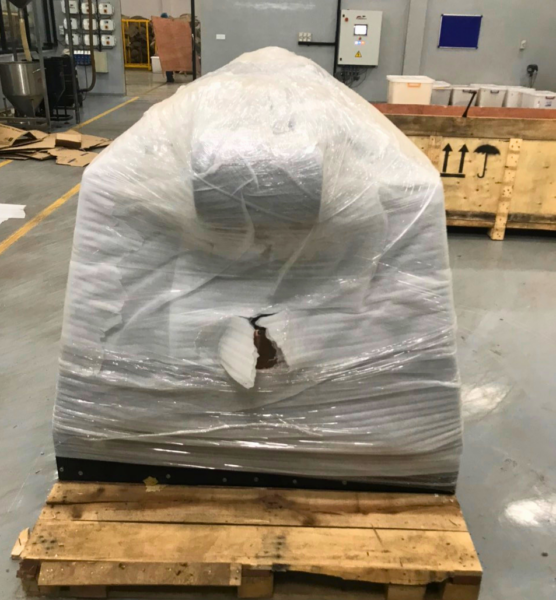
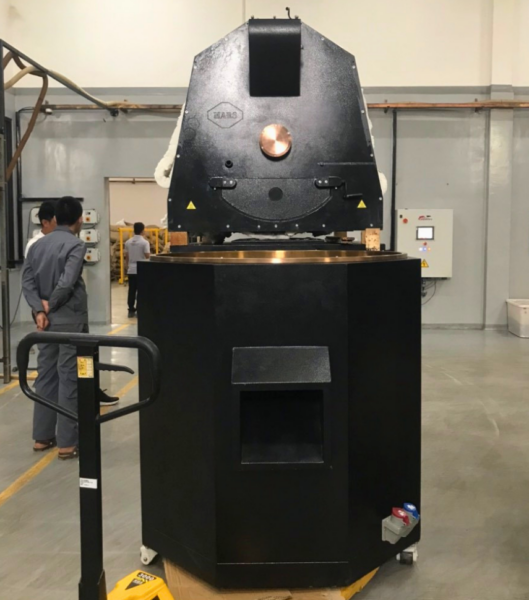
The industrial coffee roaster body prepared before being installed into the production line.
In a roast batch, operators often pay attention to temperature, time, bean color, aroma, and development speed. But at the 90kg scale, there is another factor that cannot be ignored: roasting smoke.
When coffee enters the stronger development stages, smoke, odor, chaff dust, and hot air begin to increase. If only a few small batches are being roasted, a basic ventilation system may still be sufficient. But with a 90kg line operating continuously, the smoke accumulated from each batch directly affects the factory environment.
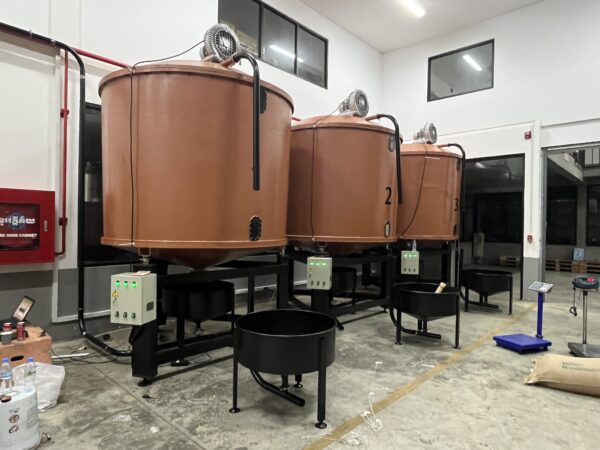
The smoke treatment machine in the Mars V5 system is responsible for receiving and treating the exhaust stream generated by the roasting process. This equipment helps reduce smoke, reduce odor, limit chaff dust from escaping into the production environment, and support cleaner long-term factory operation.
The important point is that the smoke treatment machine does not operate separately from the production line. It is included in the overall logic of the system. When the roaster operates, the exhaust stream is directed to the treatment system. When the line runs multiple batches continuously, the smoke treatment machine helps prevent the factory from being overloaded by smoke and odor after each roasting cycle.
For medium and large enterprises, this is a component with very high practical value. It helps improve working conditions for staff, creates a more professional factory image when customers visit, and reduces risks arising from smoke, dust, and odor in the production area.
A large roasting system cannot only ask, “How many kilograms can it roast per batch?” It must also answer the question: if it roasts many batches continuously, will the factory remain clean, stable, and easy to control?
That is why the smoke treatment machine becomes an important part of the complete Mars V5 production line configuration.
A roast batch does not end as soon as coffee is discharged from the drum. After leaving the roaster, the beans still retain heat. If cooling is not fast and stable enough, the beans may continue developing unintentionally, changing the sensory profile and uniformity of the batch.
Therefore, cooling is part of quality control, not a secondary stage.
After cooling, the coffee passes through the destoner. In industrial production, destoning helps remove heavy impurities that may still exist in the raw material. This is an important step to protect downstream equipment and reduce the risk of defects in the finished product.
A small stone entering the grinding or packaging stage can damage equipment, affect customer experience, or create after-sales handling costs. The destoner helps the factory eliminate that risk before the coffee is transferred into storage silos.
If the smoke treatment machine controls the exhaust stream of the roasting process, then cooling and destoning control the post-roast coffee flow. These two equipment groups help the factory manage both the operating environment and finished-product quality at the same time.
5 Roasted Coffee Silos: Finished Products Stored in an Organized Way
After destoning, the coffee is transferred into 5 roasted coffee silos, each with a capacity of approximately 1 ton. This is the area where the roasting stage is completed and also where the factory prepares for the next production plans, such as blending, grinding, packaging, or internal stock transfer.
The 5 post-roast silos allow the business to clearly separate finished products. Each silo can represent one coffee type, one roast profile, one product line, or one specific order.
For example:
Silo 1 stores dark-roasted Robusta for Vietnamese phin coffee. Silo 2 stores medium-roasted Robusta for commercial products. Silo 3 stores Arabica for espresso blends. Silo 4 stores coffee roasted according to a dedicated customer profile. Silo 5 stores finished coffee waiting for blending or packaging.
This storage structure helps the factory reduce mix-ups between batches, manage post-roast inventory more effectively, and control quality by product group. In large-scale production, clear storage organization directly affects delivery speed and product stability.
Benefit 1: Optimizing Labor Without Removing the Human Role
Automation does not mean removing people from the factory. Automation helps people avoid repetitive, heavy, error-prone, and hard-to-control tasks.
In the Mars V5 90kg system, operations such as moving bags, manual weighing, manual feeding, preparing the next batch, and transferring coffee to storage are significantly reduced. Operators shift into the role of monitoring, checking parameters, managing profiles, and controlling quality.
The addition of the smoke treatment machine also helps reduce environmental pressure for the operating team. When smoke and odor are handled more effectively, staff can work in a cleaner space and are less affected by roasting smoke that may last across many batches.
This is an important shift. A professional factory does not need too many people at manual handling points. It needs a team that understands the process, can read data, and can control the system.
Benefit 2: Reducing Errors at the Most Error-Prone Points
In coffee production, errors do not only occur inside the roasting drum. Errors can begin earlier: selecting the wrong raw material, weighing the wrong amount, feeding too slowly, loading the wrong batch, or transferring roasted coffee into the wrong storage area.
The Mars V5 line reduces errors by controlling these points through the system. The 3 green coffee silos help separate raw materials. The weighing unit controls batch size. Automatic feeding reduces heavy manual operations and waiting time. The smoke treatment machine helps control the roasting environment. The destoner removes heavy impurities. The 5 post-roast silos separate finished products.
Each stage reduces part of the risk. Together, the system helps businesses reduce the overall error rate, especially in an environment with many batches, many shifts, and many product lines.
Benefit 3: Synchronizing Quality as Output Increases
A small roastery can control quality through the direct experience of a few people. But when moving into industrial scale, that approach is no longer enough.
The larger the output, the higher the requirement for consistency. Customers do not only need one good batch. They need this month to match last month, the morning shift to match the evening shift, and the first lot to match the next lot.
Mars V5 supports quality synchronization by standardizing the foundation: batch weight, feeding timing, operating sequence, roast profile, smoke treatment, cooling, destoning, and post-roast storage. When the operating foundation is stable, the roasting team has more room to control the sensory profile, development, and consistency of the product.
The Economic Equation: Profit Comes from Minutes That Are Not Wasted
With a 90kg machine, assuming a roast profile takes 20 minutes, theoretical output can reach approximately 3 batches per hour, equivalent to 270kg per hour. If operating for 8 hours, theoretical output is 2.16 tons per day. If operating for 16 hours, the figure is 4.32 tons per day. If production is organized for 24 hours, the system can reach 6.48 tons per day under ideal conditions.
In actual operation, time must be deducted for maintenance, quality checks, profile changes, cleaning, and other production factors. But the issue here is not the absolute number. The issue is the ability to reduce waiting time between batches.
If each cycle saves 2–3 minutes of material preparation time, after dozens of batches per day, the factory can recover many production hours each month. Those hours can become additional output, reduced overtime, or lower pressure on staff.
Profit also comes from reducing errors. If a factory produces 100 tons per month and reduces only 0.3–0.5% of loss caused by incorrect weighing, material mix-ups, or reprocessing errors, the preserved coffee volume can be equivalent to 300–500kg per month. With an average finished product value of VND 100,000–150,000 per kg, the retained value can reach approximately VND 30–75 million per month.
In addition, there are labor costs. If the system helps reduce one direct worker per shift and the factory operates three shifts per day, the business can reduce the equivalent of three manual handling positions. With an average cost of VND 10–12 million per person per month, labor savings can reach approximately VND 30–36 million per month.
The smoke treatment machine also contributes to the economic equation in a less visible but very practical way. When the roasting environment is cleaner, the factory reduces ventilation pressure, lowers residual odor in the production area, reduces additional cleaning time, and creates better conditions for long-hour operation. For factories that regularly welcome customers, partners, or inspection units, a line with good smoke treatment also enhances the professional image and credibility of production capability.
Therefore, economic efficiency does not come from a single point. It comes from four combined layers: reduced waiting time, fewer errors, less repetitive labor, and better control of the operating environment.
Capability Is Proven on Site
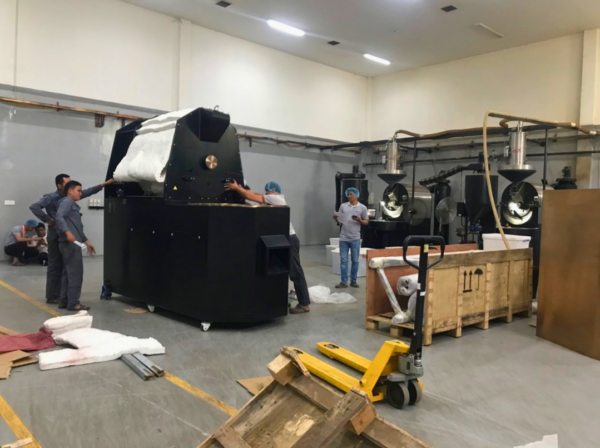
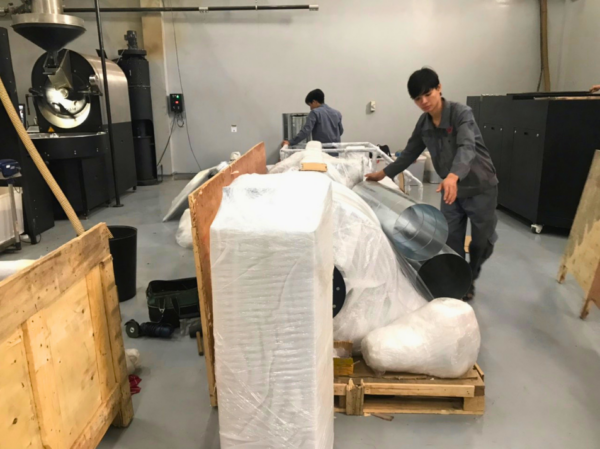
A 90kg production line cannot be proven by drawings alone. It is proven on site: the machine is transported into the factory, equipment units are assembled, silos are positioned, pipelines are connected, the smoke treatment system is arranged, and the system is programmed and test-run.
That is the most difficult part of industrial projects. It is not enough to manufacture the machine. The implementation team must understand factory layout, raw material flow, smoke exhaust direction, installation position, operational safety, and future maintenance accessibility.
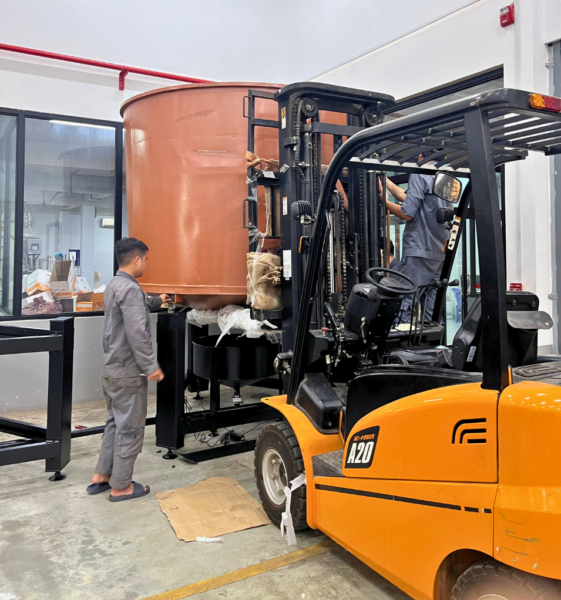
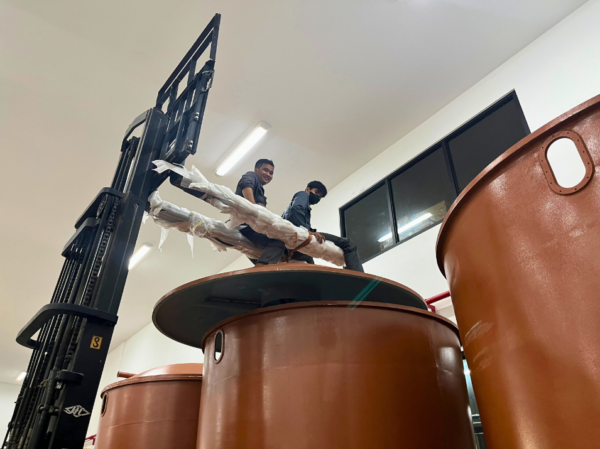
The project images clearly show this process: from the machine body and equipment modules to transportation by specialized vehicle, assembly with forklifts, silo synchronization, and completion of the production line. These are visual proof of Mars Roaster’s capability to implement complete production lines.
Components of the coffee roasting system prepared before assembly.
The 90kg roaster body prepared before assembly.
Technicians assembling the 90kg coffee roaster inside the factory production area.
From Equipment to Factory Capability
The final point a business should see in this project is not the size of the 90kg machine. What it should see is the capability to organize production.
A system with 3 green coffee silos, automatic weighing, rhythm-based feeding, a 90kg roaster, a smoke treatment machine, a destoner, and 5 finished-product silos shows that the factory is moving into a structured operating model. Raw materials are separated. The next batch is prepared in advance. Smoke and odor are treated systematically. Finished products are stored by group. Operators monitor the system instead of handling every heavy task manually.
This is the foundation for businesses to expand output without sacrificing stability. When the process has rhythm, data can be monitored, the production environment is controlled, and manual operations are reduced, the factory has more room to focus on what matters most: coffee quality and business efficiency.
Mars Roaster and the Capability to Implement Complete Roasting Lines
The Mars V5 90kg coffee roaster project is proof of Mars Roaster’s capability to implement complete production lines. From configuration design, equipment manufacturing, transportation, installation, silo synchronization, smoke treatment arrangement, control programming, and system test-running, the entire process is implemented according to the actual needs of the factory.
For medium and large enterprises, investing in an automated roasting system is not only an investment in equipment. It is an investment in long-term production capability: less dependence on manual handling, fewer operational errors, greater repeatability of quality, better control of the production environment, and more effective management of operating costs.
A good roaster creates a good roast batch. A good production line creates stable production capability. And a properly designed system helps businesses turn capacity into profit.
Consultation for a 90kg Automated Coffee Roasting System
Mars Roaster provides coffee roasting machines and automated roasting line solutions based on the actual needs of each factory.
If your business needs to build a roasting system from green coffee silos, automatic weighing, automatic feeding, industrial coffee roasting, smoke treatment, destoning, and finished-product storage silos, Mars Roaster can provide configuration consulting that matches your target output, factory layout, and product direction.
MarsBot
Mars Roaster xin chào! MarsBot có thể giúp anh/chị chọn máy rang cà phê phù hợp.