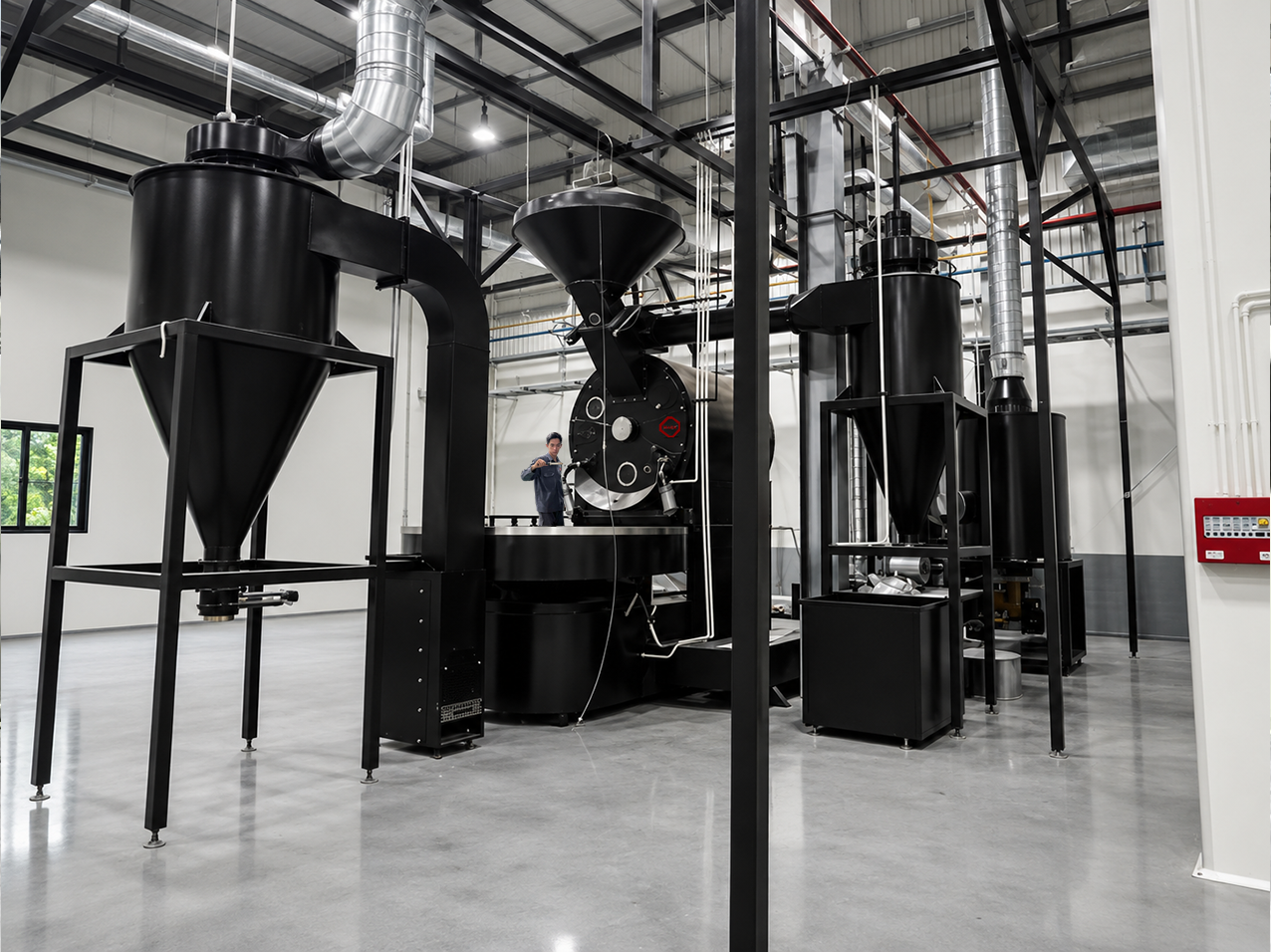
Mars V5 Coffee Roasting System with Two 30kg Roasters for an Export Factory
Two Mars V5 30kg Roasters in One Production Line: When an Export Factory Steps into Smart Roasted Coffee Production
A factory that is already familiar with exporting green coffee often looks at coffee very differently. They do not see coffee beans merely as raw materials. They see growing regions, moisture levels, screen sizes, bean defects, processing standards, warehouse capacity, and the requirements of overseas markets.
Green coffee processing factory
But when moving into roasted coffee, the game changes.
It is still the same coffee bean, but after roasting, its value no longer depends on the initial green bean quality alone. The new value lies in the roast profile, consistency between batches, blending capability, finished-product storage, and the ability to reproduce production according to standards.
The Mars V5 coffee roasting system project with 02 roasters, each with a capacity of 30kg per batch, was implemented for an enterprise with a strong foundation in green coffee export in Gia Lai. This business owns a professional-scale coffee processing line and wants to leverage its raw material advantage to expand into roasted coffee for both the domestic and export markets.
The challenge was not simply to “install a roaster.” The real challenge was to build a production line smart enough for stable production, clean enough for a professional factory environment, flexible enough to process multiple product lines, and data-driven enough for quality management.
Mars Roaster implemented this system with a configuration of 02 30kg roasters, hot-air roasting technology, Mars V5, automatic feeding, smoke treatment, cooling, destoning, finished-product storage silos, and connection to the coffee mixer.
Mars V5 coffee roasting line with 02 roasters of 30kg per batch, silo system, pipelines, and synchronized processing equipment.
Why Does a Green Coffee Exporter Need a Smart Roasting System?
For a green coffee export business, the greatest advantage is its understanding of raw materials. They have better control over input quality than many businesses that only purchase coffee through intermediaries. However, when they want to export roasted coffee, the raw material advantage must be transformed into a product advantage.
This requires three new capabilities.
First is the capability to roast consistently. Each market may require a different roast level, sensory style, and product standard.
Second is the capability to organize production. After roasting, coffee needs to be cooled, destoned, stored, and blended under controlled conditions.
Third is the capability to prove the professionalism of the factory. Export customers do not only look at coffee samples. They also look at the process, equipment, factory layout, smoke and odor control capability, and product consistency.
Mars V5 was selected because the system helps the business bring the roasting process into a clearer model: profile-based, controlled, equipment-connected, and capable of operating as a production line.
02-Roaster 30kg Configuration: More Flexible Than a Single-System Setup
Using 02 roasters of 30kg per batch creates a major advantage: the factory is no longer dependent on a single production rhythm.
When output is required, both machines can operate in parallel. When multiple product lines need to be developed, each machine can handle a different profile group. One machine can run dark-roasted Robusta for Vietnamese phin coffee or commercial products, while the other can process Arabica, blends, or custom orders.
The 02-roaster configuration also gives the factory more flexibility in production planning. For export orders, this flexibility is very important. The business can divide the production schedule by market, by customer, or by product line without making the entire production line dependent on a single machine.
More importantly, both machines are placed within the same system logic: feeding, roasting, cooling, post-roast processing, storage, and transfer to the mixer. Therefore, whether one machine or two machines are operating, the coffee flow is still organized according to a controlled process.
Mars V5 2-roaster 30kg coffee roasting system operated on a single control platform.
Hot-Air Technology and Mars V5: Controlling Roast Batches in the Spirit of SCA
In professional coffee production, a roast profile is not only about time and temperature. It is how the factory controls the energy applied to the bean, airflow, development rate, uniformity, cooling, and the ability to reproduce the roast batch.
The hot-air technology in the Mars V5 system allows coffee beans to interact with a stream of hot air during roasting, supporting more stable heat transfer control. This is especially suitable for factories that need to produce many batches continuously while maintaining consistency.
Mars V5 helps upgrade the roasting process from manual operation to profile management. Operators do not only evaluate a roast batch through experience; they can also monitor parameters, check stability, and reproduce the process for each product line.
This is a point the business highly values: the technology does not remove the role of the roaster, but helps the roaster control the process better. With an export-oriented direction, this is very important because a good product must be reproduced consistently across multiple shipments.
Mars V5 control interface for the smart coffee roasting system.
Automated Production Line: Reducing Manual Operations at the Most Error-Prone Points
In a coffee roasting factory, errors often do not come from overly complex tasks. They usually come from repeated operations: incorrect weighing, wrong loading, wrong discharge, storing coffee in the wrong silo, or mixing the wrong ratio.
The Mars V5 system is designed to reduce these error points.
Green coffee is transferred into the feeding system. The weighing unit helps control the correct weight before the coffee enters the roaster. The two roasters operate according to profiles. After roasting, the coffee is cooled, passes through the destoner, and is then transferred into finished-product storage silos. From the silos, the coffee continues to be fed to the mixer for blending according to formula.
This process helps the factory reduce its dependence on staff having to remember and manually handle each stage. Operators shift into the role of monitoring the system, checking parameters, and controlling quality.
For medium and large enterprises, this is an important change. As output increases, the fewer repeated manual operations there are, the lower the risk of variation between production shifts.
Smoke Treatment: A Factory Standard for Long-Term Production
Coffee roasting does not only create aroma. At an industrial scale, it also generates smoke, odor, hot air, and chaff dust. If these are not properly treated, the factory environment will be affected after many continuous batches.
Therefore, the smoke treatment system is an important part of the project. When two 30kg roasters are operating, the exhaust stream needs to be directed to the treatment unit to reduce smoke and odor and support a cleaner factory environment.
For an export-oriented business, this factor cannot be overlooked. International customers often care about the professionalism of the production process, from equipment arrangement and factory hygiene to operational safety and environmental control capability.
A roasting system with good smoke treatment helps the business feel more confident when welcoming customers, partners, or factory assessment teams. It shows that the business is not only investing in the product, but also in the production environment.
The smoke treatment system is integrated into the Mars V5 roasting line, supporting smoke and odor control during operation.
Finished-Product Silos and Mixer: Standardizing the Post-Roast Stage
After roasting and destoning, the coffee is transferred into finished-product storage silos. This step helps the factory organize roasted coffee by type, profile, or production plan.
Storage by silo helps reduce finished-product mix-ups and supports better management before the coffee enters the blending stage. From the silos, coffee is fed to the mixer to create blend formulas.
For export products, blend formulas require high stability. Even a small change in blending ratio can change the sensory profile of the product. Therefore, connecting finished-product silos with the mixer not only helps save labor, but also helps control the consistency of the final output.
Benefits for Medium and Large Enterprises
The Mars V5 system with 02 30kg roasters delivers clear value across four benefit groups.
Labor optimization: Feeding, weighing, post-roast coffee conveying, and transfer to the mixer are automated at multiple points. Staff reduce heavy manual operations and shift into system supervision.
Reduced error rate: The system helps reduce common errors such as incorrect weighing, wrong loading, product-line mix-ups, or storing finished coffee in the wrong group.
Quality consistency: Mars V5 supports profile management, hot-air technology supports roasting stability, and the silo and mixer system helps organize the post-roast stage more effectively.
Economic management: When production follows a defined process, the business can more easily monitor loss, productivity, labor cost, order fulfillment capability, and operating efficiency by production shift.
These are very practical benefits for businesses that want to move from green coffee into roasted coffee products. Especially with an export-oriented direction, production capability must be proven by the system, not only by words.
Mars Roaster’s Capability: Implementing Systems, Not Just Selling Machines
A complete production line project requires more than manufacturing roasters. The implementation team must understand factory layout, raw material flow, roaster positioning, pipelines, smoke treatment, finished-product silos, mixers, and the actual operating process.
Mars Roaster participates in the entire implementation logic: configuration consulting, equipment layout, installation, system connection, operation testing, and user training. This is an important capability for medium and large enterprises, because they need a partner that understands real production, not just a supplier of standalone equipment.
The Mars V5 project with 02 30kg roasters in Gia Lai shows a clear development direction: a green coffee export business can step into roasted coffee production with a system that is properly invested, smart, and scalable.
Inspecting the real operation of the Mars V5 smart coffee roasting system together with the customer.
Consultation for Mars V5 Coffee Roasting Systems
Mars Roaster provides coffee roaster solutions and automated roasting lines based on the actual needs of each factory.
If your business is planning to expand from green coffee into roasted coffee products, or needs to build a roasting line for export markets, Mars Roaster can consult on a suitable system from feeding, weighing, hot-air roasting, smoke treatment, cooling, destoning, finished-product silos, to the mixer.
Hotline/Zalo: 09.3205.2211
MarsBot
Mars Roaster xin chào! MarsBot có thể giúp anh/chị chọn máy rang cà phê phù hợp.