Why Is Consistent Coffee Quality the Decisive Factor for Roastery Growth?
Why Is Consistent Coffee Quality the Decisive Factor for Roastery Growth?
Consistent coffee quality is no longer a competitive advantage—it has become a mandatory condition for roasteries to scale up, retain wholesale clients, and achieve long-term growth.
As the coffee industry increasingly shifts toward chain models, wholesale distribution, and exports, the criteria for evaluating a roastery’s capabilities have gradually changed. The market is no longer concerned only with whether the coffee “tastes good,” but places growing emphasis on quality consistency. This includes the ability to maintain uniformity across roasting batches and preserve flavor profiles while scaling production. For many roasteries, this is no longer a competitive edge, but a decisive factor in long-term growth.
For decades, the success of Vietnam’s coffee industry has been closely tied to production volume. Vietnam currently ranks second globally in total coffee output, after Brazil, and is the world’s largest exporter of Robusta coffee. According to forecasts from the United States Department of Agriculture (USDA), Vietnam’s coffee production for the 2025–2026 crop year is estimated at approximately 31 million bags.
Alongside production growth, Vietnam’s coffee export value surpassed USD 8.6 billion in 2025. This milestone not only reflects record figures, but also signals a deeper shift from quantity toward value and sustainability.
Vietnam is the world’s second-largest coffee exporter.
This indicates that the international market is shifting its focus from output volume to real value, where each coffee bean is assessed based on quality, consistency, and its ability to generate long-term value after roasting.
This transition has led to a significant change at the roastery level. In the early stages, many roasteries can gain an advantage through a strong roast profile or a few standout batches. However, when moving into wholesale, chain supply, or export markets, evaluation criteria extend beyond flavor alone.
At this stage, the market demands the ability to maintain stable and consistent quality across multiple consecutive roasting batches, ensuring uniform customer experience and creating a foundation for long-term brand development.
As a result, consistent coffee quality has become an unspoken standard when working with wholesale clients, chains, and export partners. While this requirement is rarely stated explicitly in contracts, it is always used to assess a roastery’s true operational capability.
In practice, just a few inconsistent batches can disrupt customer experience on a large scale, directly undermining brand trust across an entire chain.
Why Does Maintaining Consistent Quality Become More Difficult as a Roastery Scales?
Maintaining consistent quality is a difficult challenge for large-scale roasting plants.
Coffee roasting is a technical process that requires simultaneous control of multiple factors, including temperature, time, airflow, bean moisture, and heat development rate at each stage. Only when these variables are precisely and synchronously managed can coffee flavor remain consistent across batches.
At a small scale, roasters can rely on personal experience to compensate for deviations and maintain acceptable quality. However, as production volume increases, batch counts grow, and multiple operators become involved, this approach quickly reveals its limitations. A single parameter that is not consistently controlled can cause flavor deviations between batches. At that point, each roast is no longer a calculated outcome, but a trial with inherent risk.
The core issue for many roasteries is not machinery itself, but the lack of a technical control foundation capable of maintaining consistent quality as production scales.
Major Coffee Markets Are Setting New Standards for the Industry
EU – Vietnam’s largest coffee market.
Large coffee-consuming markets such as the EU, Japan, South Korea, and Singapore are increasingly tightening their evaluation criteria for roasteries. Requirements now extend beyond food safety to include flavor consistency, traceability, and long-term supply reliability.
According to data from Vietnam’s agricultural authorities, the EU currently accounts for nearly 47% of Vietnam’s total coffee exports, with export value exceeding USD 4 billion in the 2024–2025 crop year. Notably, while export volume increased only slightly, export value rose by more than 55%, indicating that the market is willing to pay higher prices for products that meet consistent quality standards.
At the same time, developed Asian markets such as Japan and South Korea recorded strong growth in coffee import value in 2025. These are highly demanding markets, where flavor uniformity and shipment reliability are decisive factors for long-term partnerships.
As a result, concepts once considered premium—such as specialty coffee, fine Robusta, and supply chain traceability—are gradually becoming industry standards. In practice, deeply processed coffee accounts for only about 10% of total volume, yet contributes more than 20% of export value, thanks to better quality control.
Reality also shows that many roasteries experienced rapid growth driven by market demand, only to plateau when quality failed to keep pace with scale. As volume increases, small roasting deviations are magnified, leading to loss of trust among wholesale clients.
Therefore, long-term growth does not come from a few successful batches, but from systems capable of consistently reproducing quality. Coffee roasting is shifting from intuition-based practices to data-driven roasting, where technology enables better control as operations expand.
Ultimately, consistent coffee quality is not only about customer retention—it is the foundation of a brand. Only when customers trust that today’s cup will taste the same months later can a brand truly endure.
The Role of the Roastery in the Quality Standardization Journey
In reality, very few roasteries struggle because they cannot produce good coffee. Most plateau because they cannot maintain that quality as scale changes.
As scale expands, batch-to-batch deviations become more likely; as order volume increases, quality control pressure intensifies. At a certain point, non-standardized operational systems become invisible barriers that constrain a roastery’s growth potential.
Standardizing coffee roasting is therefore not about replacing craftsmanship, but enabling craftsmanship to perform consistently under all production conditions—where quality is controlled by systems rather than dependent on individuals.
This allows roasteries to scale while preserving core flavor profiles, building brand credibility, and participating more deeply in the global value chain—where consistent coffee quality is the foundational factor for long-term growth and brand positioning.
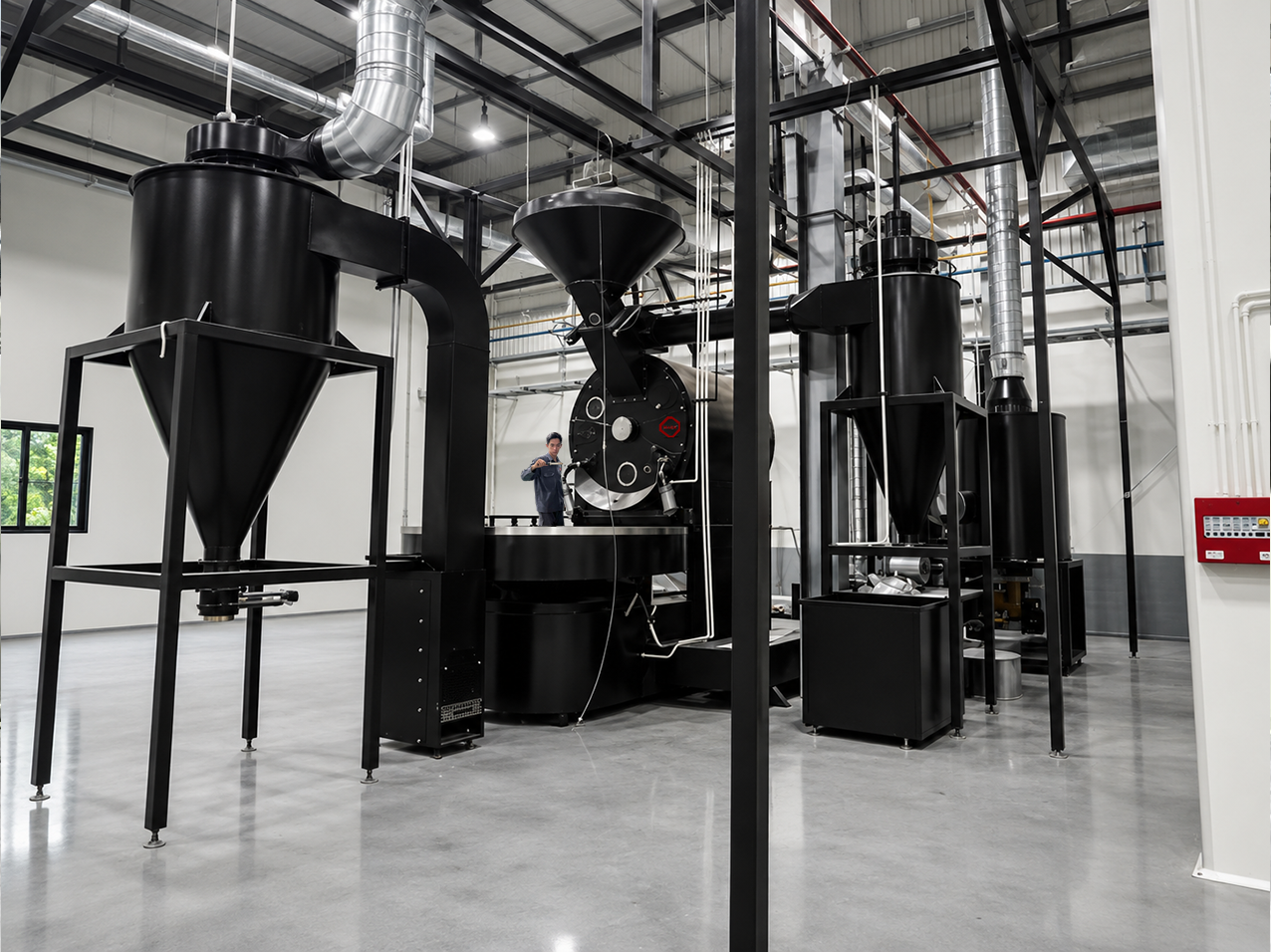
The intelligent, synchronized, and quality-standardized coffee roasting system developed by Mars Roaster.
Consistent Coffee Quality Requires a Reliable Roasting Technology Platform
As the market increasingly emphasizes quality consistency and scalability, many roasteries are reassessing the role of technical infrastructure in their growth journey.
In this context, roasting technology developers like Mars have chosen a path focused on standardization and quality reproducibility through industrial automatic roasting solutions—from earlier generations to intelligent systems such as Mars V5. This approach reflects a clear industry trend: sustainable growth does not come from momentary inspiration, but from the ability to maintain consistent quality as scale and market demands continuously evolve.
Investing in a standardized roasting platform is a way to ensure precise and consistent bean quality, thereby laying a solid foundation for long-term and sustainable brand development.
If you are considering the challenge of maintaining quality consistency while scaling your roastery, please leave your contact information. The Mars team is ready to discuss and share technical perspectives tailored to different roastery models.
MarsBot
Mars Roaster xin chào! MarsBot có thể giúp anh/chị chọn máy rang cà phê phù hợp.